
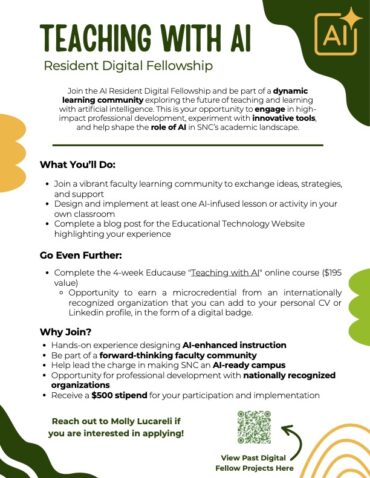
Faculty AI Digital Fellows
8 Faculty participated in the Teaching with AI Resident Digital Fellowship” during the 25-26 academic year. Digital Fellows completed the Educause “Teaching with AI” course and designed and implemented at least one AI-infused lesson in their classroom. They conducted pre and post assessments with their students to measure any change in knowledge/use/perception. All Digital Fellows will reflect on their experience in a blog post (coming soon.)
“This fellowship has been highly beneficial! Getting feedback from colleagues on my AI-incorporated assignment was helpful in figuring out what works and what needs refinement.” ~Dr. Alexa Trumpy, Sociology
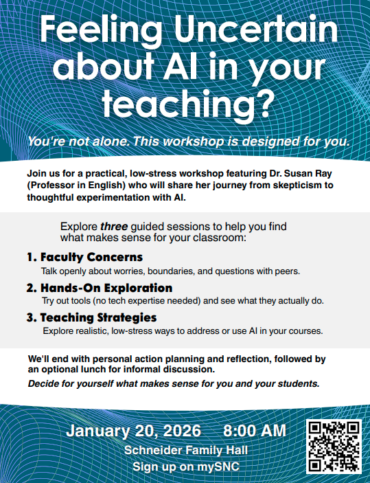
Teaching with AI – Faculty Workshop
Faculty Development and Educational Technology co-hosted a hands-on workshop on January 20, 2026, guiding faculty through concerns, exploration and teaching strategies. The workshop featured keynote speaker, Dr. Susan Ray, a professor in English who shared her journey in adopting AI in a meaningful way in her classes. The feedback on the workshop was overwhelmingly positive.
“It was a great event. I think it helped the skeptics gain some understanding, while allowing the all-in types the ability to see that caution is needed.” ~Workshop Participant
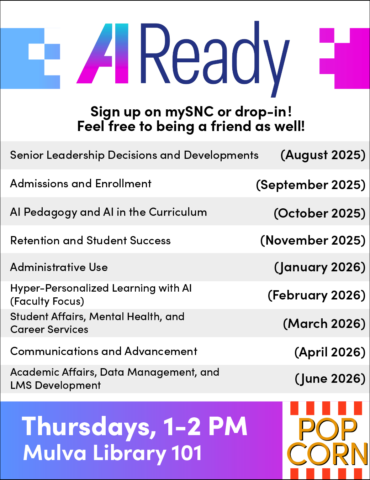
CIC AI Ready Webinars
AI Ready, a national initiative of the CIC, brings together faculty and staff from colleges and universities across the country for monthly webinars exploring the power of AI in higher ed. Many WAICU schools, including SNC, are actively participating. This program is sponsored by Business and Finance. A repository of AI Resources from the AI Ready Webinars can be found on WAICU Connect.
“I really appreciate SNC putting on these webinars for us so we can understand AI and how some institutions are using it. I have learned a lot, and it’s nice to collaborate with other offices on campus.” ~Kristen Schiedermayer
AI Courses Offered
PHIL 227 – Ethics of AI
An introduction to the history and philosophy of artificial intelligence. The course will include an investigation into what minds are and the efforts to create artificial minds. We’ll think about a variety of ethical issues involved in both the design and use of artificial intelligence, considering case studies, as well as a consideration of the risks involved in the future of AI.
CSCI 340, Artificial Intelligence
The study of artificial intelligence involves the exploration of the principles and techniques involved in programming computers to do tasks that would require intelligence if people did them.
State-space and heuristic search techniques, logic and other knowledge representations, and statistical and neural network approaches are applied to problems such as game playing, planning, the understanding of natural language and computer vision. Students will implement real-time systems that use feedback loops and the techniques above to modify the behavior of the system. Prerequisites: CSCI 220 and CSCI 225.
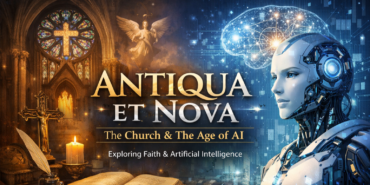
Mission Lunch & Learn
The Office of Mission and Heritage and Information Technology Services (ITS) co-sponsored a Lunch and Learn event to explore Antiqua et Nova, the Vatican Dicastery for the Doctrine of the Faith’s recently released Note on the Relationship Between Artificial Intelligence and Human Intelligence.
Educause – Teaching with AI
20 faculty completed the Teaching with AI course, by Educause. Teaching with AI is a two-week online course, designed to deepen participants’ understanding of artificial intelligence and equip them with practical strategies for integrating it meaningfully into their teaching, from course design and assignment redesign, to supporting academic integrity and personalizing student learning.